bet your bottom dollar
no one ever talks about Hoof Hearted

I found a scratch-off lotto ticket at the bottom of one of my drawers, buried under old makeup and a litany of hairbands. It was a winner, but it was bought in New York, so it was really just an uncashable $1 check. Hence why it fell into the abyss of my desk, forgotten and essentially worthless.
Scratchers were my brother’s and my favorite when we were little. On our road trips to upstate New York, my parents would buy them at rest stops, and we would fish in the cracks of the backseat for coins to scratch the latex layer off. I didn’t win very often, but I definitely won more than my brother.
We would buy new ones on the way back home, a dollar won immediately funneling into buying another scratcher. And the cycle started again.
Every summer, one of those road trips upstate was with a purpose other than going to my grandfather’s house and riding four-wheelers and hiking and going to Mine Kill State Park.
We would go for the Travers.
These days always started at the crack of dawn for my dad, brother, and uncle, staking their claim on a spot at the track. Everyone else—sometimes just me and my mom, sometimes a crew of cousins and grandparents and aunts—would come later. We would bring snacks and extra chairs, a tablecloth, cups, and a cooler.
Horse races are one of those places that are distinctly their own, unreplicable even through a television or broadcast. But every horse race I’ve ever been to feels eerily the same. They all smell the same, taste the same, look the same.
The chips that were supposed to be honey barbecue somehow taste like mesquite after too many hands rifle through the bag. Within an hour of arriving, the cuticles of pedicured feet are caked with dirt because sandals leave toes vulnerable to dust. Plumes of cigar smoke catch in the wind and are carried over the picnic tables and homemade punch bowls. Seersucker suits and blooming hats evoke a collective Candyland wardrobe.
But the betting’s the best. Fourteen chances to analyze the odds or research a horse’s trainer. My dad would never be more than three feet away from his racing program. I always just picked the horse with the best name and placed a $1 bet on him.
It adds tension and stakes, a reason to watch the race, know the jockey, look into the trainer. Winning is the goal, but the atmosphere softens the blow of a loss.
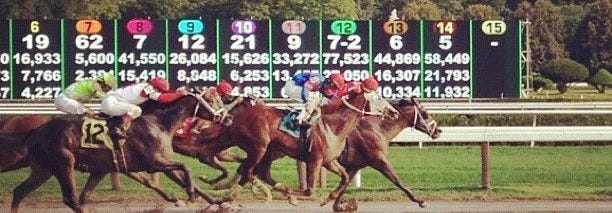
On the 13th race—the Travers—we always went to the track to watch it live. Kids lean on the railing, while college kids stand on the vintage benches that have never looked structurally sound. I would sit on people’s shoulders, a prime view of the two milliseconds when the horses sprinted by.
It’s always hard to see who wins, much harder than on the monitors by the picnic tables and barbecue chips. The anticipation grows as people wait to find out whether their horse won, whether their money will be coming back, if they’ll turn a profit.
I didn’t win often—turns out the wittiness of a horse’s name has little to no correlation to how fast he can run 10 furlongs. But I will always stand by my method of gambling.
Because someday soon I’ll be back in New York, somewhere near Saratoga, and I’ll cash in that scratcher from the depths of my junk drawer and bet that dollar on some horse with terrible odds just because I think his name is clever.
And I’ll probably lose.
But that’s beside the point. A dollar bet on a losing horse goes a whole lot farther than when it sits in a wallet, an account, or a drawer. Approximately 1.25 miles, actually.
What can you even do with $1 these days? You might as well bet that bottom dollar.
Maybe you’ll be able to rub it in your brother’s nose, or maybe you’ll still have to listen to your dad brag about his supreme horse racing literacy for months.
Or maybe you’ll get to experience the feel of a cloudless, late August sky at the beginning of June or the end of July—a product of reins and racing and rye.
It’s something only a losing bet can buy.